
Anthropic put a meter on the rest of the agent
On June 15, programmatic Claude usage moves to a separate $20–$200 API-priced credit. The email arrived this morning. Here is what it actually means and what it teaches about building on someone else's compute.
The email arrived this morning with the orange star and the warm-business voice.
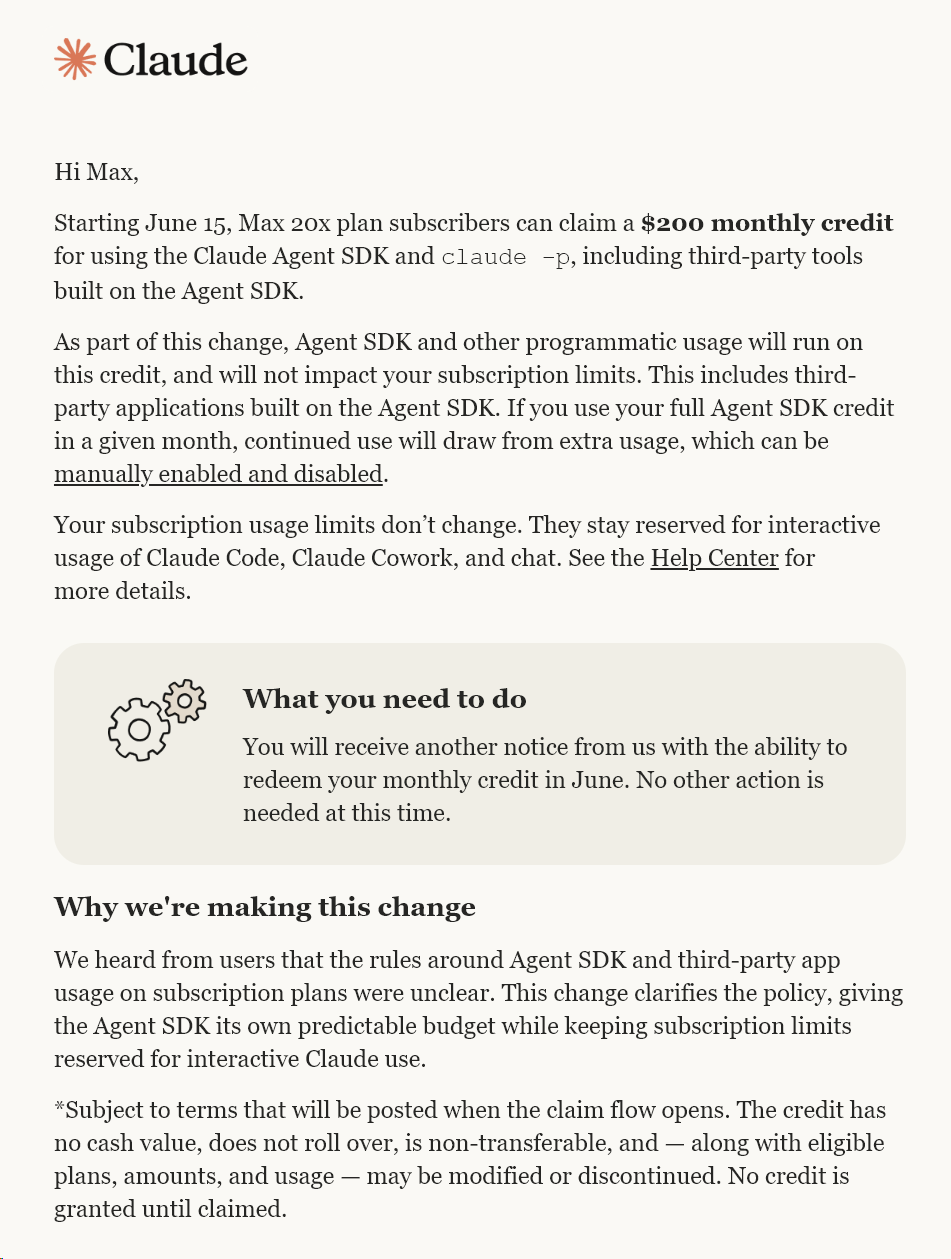
Starting June 15, my Max 20x plan gets a $200 monthly credit for the Claude Agent SDK and claude -p. Anything built on top of those (Conductor, OpenClaw, third-party harnesses) draws from the same credit. After the credit runs out, programmatic usage stops, unless I opt into "extra usage" billed at API rates. Subscription limits for interactive Claude Code and chat don't change.
That's the whole change, as told to me by my plan.
I read it twice. It's one of those carefully warm announcements where the news lives in the negative space. "You will now receive a $200 monthly credit" sounds additive. The interesting question is what was there before that's no longer there.
The math
Until June 15, all my Claude usage shared one bucket. Interactive Claude Code in the terminal, chat on the web, headless -p scripts, GitHub Actions, anything driven through the Agent SDK. Same subscription rate limit. The rate limit was generous enough that with aggressive scripting you could push through a volume of tokens that would cost roughly $2000 a month at API prices. The exact number depends on how hard you flirted with the 5-hour windows, but the order of magnitude is right. The heaviest users were getting about 10× the API-equivalent value out of a $200 plan.
After June 15 the pool splits. Interactive stays where it was. Programmatic gets its own credit that, by deliberate coincidence, equals what you pay. Pro: $20. Max 5x: $100. Max 20x: $200.
For a heavy scripter that's roughly ten times less budget for the part that actually mattered, wrapped in language that reads like a bonus. For someone who never touched the SDK that's a small free credit appearing in an account that otherwise behaves identically.
Both descriptions are accurate. The question is which one is mine.
Two readings, both true
Until last week, running a third-party harness on a Claude subscription was technically against terms and practically tolerated, with periodic account suspensions to remind people the tolerance was conditional. The new arrangement makes it explicit and legal. You get $200 of API-priced budget for the use case that wasn't really allowed before, plus your interactive subscription continues to work the way it always did. People without scripts get a small free credit. The minority who were burning $2000-equivalent of compute on $200 of subscription stop dragging shared rate limits down for everyone else.
That's the bullish reading. It's correct.
There's also a bearish one. The shape of the change is a 10× downgrade for the programmatic case, framed as a gift, by a company that has been moving the goalposts on rate limits for months. The "claim your free credit" language is meant to land softly, but the new ceiling sits well below the old one for the use case being metered. The people who built the loudest harnesses, the ones who told their colleagues to switch to Claude a year ago, are the ones who lose the most.
That's also correct.
I keep going back and forth between them, honestly. The change isn't a single number. It's a re-segmentation. Interactive users who never max out token volume get the same deal. Programmatic users who do, get charged at something closer to what their compute actually costs Anthropic.
If your work doesn't lean on claude -p, June 15 looks like June 14 plus pocket change. If your work was a stack of headless scripts, it's a 10× smaller budget for the part that mattered.
What's actually going on
Read from Anthropic's side, the picture is simpler than the announcement makes it sound. They don't need to win anything. They need the population of developers running headless scripts on subscription billing to stay small enough that subscription pricing keeps working. That's the actual constraint, not "stop all scripts".
Anthropic isn't trying to eliminate programmatic use. They couldn't if they tried, since the SDK and the CLI are their own products and headless mode is a feature they built deliberately. The point is that subscription pricing works for them only if the median subscriber is a human typing at a prompt, with natural pauses and human-shaped throughput. The 10× power users were a real workload sitting on top of pricing designed for a different workload, and that gap was getting more expensive every month as inference demand grew.
You can be irritated at the framing (the PR around this is genuinely bad) and still notice that the underlying move is a price calibration. Anthropic isn't trying to lose the developer market. They're trying to keep the developer market priced like a developer market.
The piece of me that has been running scripts against this thing for a year is irritated. The piece of me that has been pricing inference for clients sees the math and shrugs. Both pieces are real and I don't think they reconcile.
The pre-IPO revenue ramp reading is probably also partly true. Investor pressure, the $1.4T number, the enterprise pivot. None of that is load-bearing. Even without those pressures, the same arithmetic would force the same kind of move within a year. Compute isn't getting cheaper as fast as demand for it grows. The free helicopter ride was going to end on schedule.
The tmux workaround
The workaround is obvious enough that it surfaced within hours of the announcement. Run actual Claude Code in a tmux session in normal interactive mode. Drive it from an orchestrator with tmux send-keys. Hook the lifecycle events the way you'd hook them in any harness. Subscription rate limits, not API credits.
The catch is also obvious. Anthropic can detect the pattern. They probably will. When they do, someone builds a different pattern. Then they detect that one. The game continues as long as both sides find it worth playing.
This is the same equilibrium as the pricing-calibration point, seen from the other side. Anthropic doesn't need to detect every pattern. They need detection to be expensive enough that developers running headless scripts on subscription billing stay a small enough fraction of paying users that the pricing math keeps working. The other side doesn't have to win every round. Each new workaround just has to take less time to discover than the next detection rule takes to ship.
The same week as this announcement, complaints about Opus 4.7 quality compared to 4.6 have been loud. That's a different topic, but it stacks. When the model feels worse and the pricing feels worse in the same month, patience for "trust us, this is calibration" runs short. I have my own opinions about 4.7 but they're not what this piece is about.
What I'm doing about it
A lot of what I work on sits on top of this kind of infrastructure. Tools I build and use, products that ship as agent-adjacent, orchestration that drives my own workflow. When a pricing primitive moves, I see it from inside the design problem first, before I see it as a customer.
I run my orchestration in tmux with hooks already, for reasons that predate this change and have nothing to do with it. So in the narrow sense, June 15 doesn't break me. The headless scripts I might have run as claude -p from inside an interactive session, I don't run those. Partly out of taste. Partly because I never trusted the implicit subsidy enough to build production-shaped things on top of it.
The personal angle isn't the lesson, though. The lesson is that any agent harness built on a single vendor's pricing primitive has an expiry tied to that primitive. claude -p was a primitive. Cheap. Subscription-priced. Integrated. Easy to call. People built daily news briefs against it. GitHub PR bots. TDD verifiers. Image-evaluation pipelines. Custom UIs over the SDK. None of those users were doing anything wrong. They were building on a price that wasn't sustainable for the seller.
The orchestration pattern is the part that survives. Whatever sits underneath the interface, whether it's claude -p, codex, or a local model, is the part that gets replaced. If your harness is wired to claude -p specifically, the next change in the meter rebuilds your harness. If it's wired to "a CLI runs in a session I can send keys to", swapping the CLI is a configuration change.
I aim at making it cost hours, not months, to swap the model engine. That doesn't make me immune to pricing changes, nothing does, but it changes what they cost me. A rebuild becomes a routing change. Right now I run Claude for most things and Codex on a few where it's measurably better. When the next bend in this curve arrives, and it will, I want it to be a routing decision and not a rebuild.
I'll claim the credit on June 8. I'll leave "extra usage" off so a runaway script can't hand me a four-figure overage. And I'll keep doing what I was already doing.
The era of building production-shaped agent workflows on top of a subscription-priced subsidy is closing on schedule. June 15 is louder than the steps before it. There will be more.